Continuing to make things

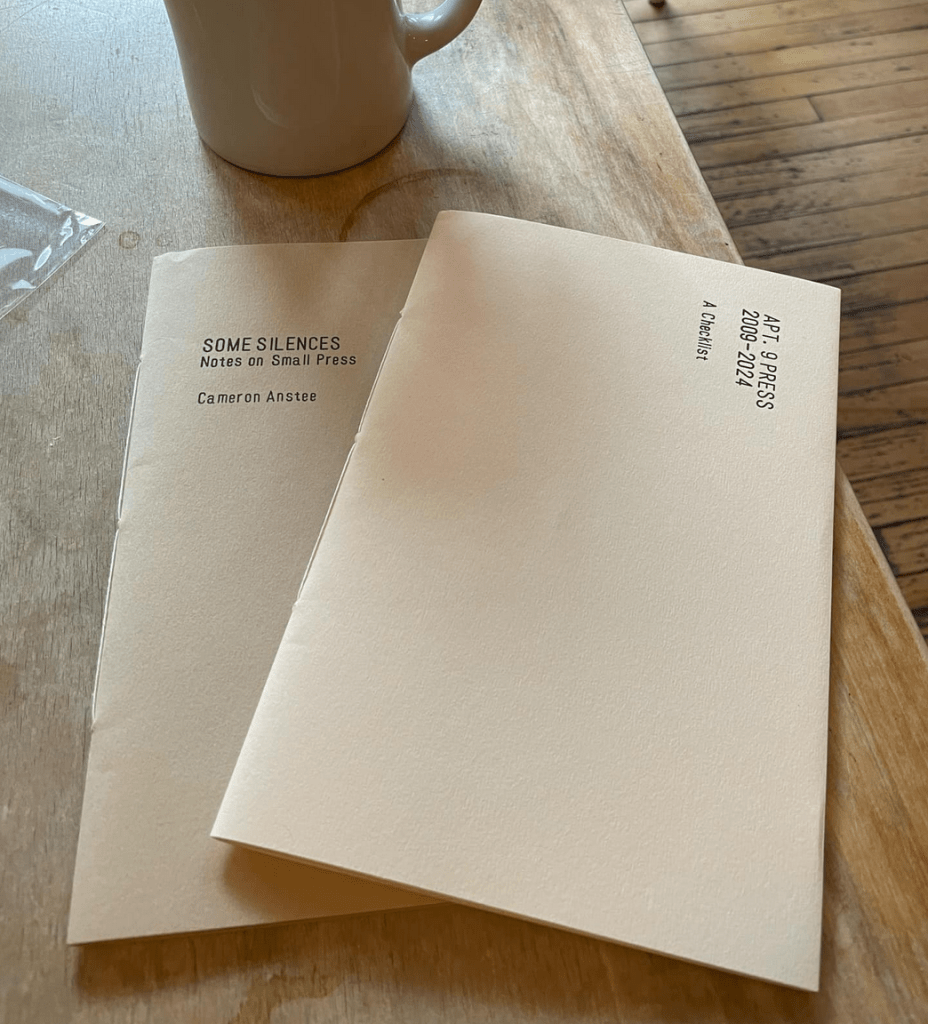
Cameron Anstee, Apt. 9 Press 2009-2024: A Checklist. Ottawa, Ontario: Apt. 9 Press, 2024, 80 copies.

–, Some Small Silences: Notes on Small Press. Ottawa, Ontario: Apt. 9 Press, 2024, 80 copies.

apt9press.com

A chapbook press lasting 15 years is certainly reason to celebrate and Cameron Anstee has done it with style, releasing two Apt. 9 Press titles to mark the occasion. They both strike me as essential for anyone with an interest in very small press publishing.

I am very glad to have the first, a checklist of publications, even if (as Anstee writes) it may be missing a few things. The introduction gives a brief history of the birth of the press, and informs us that his attractive chapbooks are still printed on a $100 laser printer.  (The covers are often rubber-stamped.) What follows is an annotated list of fifty-two chapbooks, 2 proper “books,” two folios, twelve broadsides and leaflets, and ten titles under a separate imprint.  I wish that I owned the first title, Justin Million’s Guzzles from 2009, both because I like Million’s work and, well, just because.  “This was the first manuscript solicited,” runs the accompanying note. “I made proof after proof in different formats…trying to figure out what I was doing, what I wanted to do.” Million was also one of the volunteers who wine-stained the cover of Leah Mol’s And I’ve Been Living Dangerously (2011) on a night that “One of our cats escaped” and everyone “walked to the Ottawa River and watched fireworks being shot off”. These lovely bits remind us that for some making chapbooks is just a part of everyday life.

The second title, Some Silences, is Anstee’s meditation on fifteen years as a publisher.  In it he is honest about the reach of a small press while modestly asserting its value:
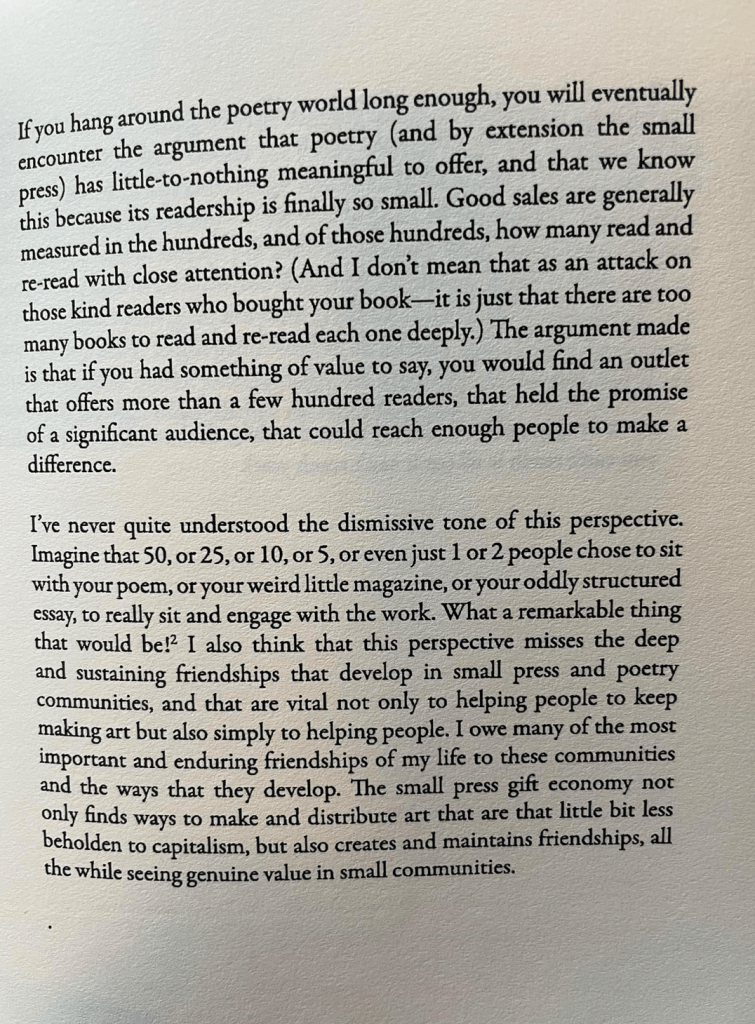
Anstee tries to de-romanticize the act of publishing poetry when he confesses that “The ego side of it is hard—continuing to make things…while knowing it will meet silence whether this year or another.” But he fails to take out all the romance, both for himself and for us.  Publishing links him to a tradition he highly values and hopes will continue after his own work is done. The small number of readers—well, it might sting sometimes, but it doesn’t take away from the one or two or three who discover an Apt. 9 title and find something meaningful in it. And for Anstee the act of making itself—printing, folding, sewing—must at this point feel like a necessary ritual.

The first title from the press that I bought was Michael e. Casteels’ Solar-powered light bulb and the lake’s achy tooth in 2015. In fact, it was the reason for starting this review blog. The latest are the two that I’m writing about here. I look forward to many more.

I never wonder why

John Levy, Guest Book for People in my Dreams. Cobourg, Ontario: Proper Tales Press, 2024, 150 copies.

propertalespress@gmail.com

This production from Proper Tales Press (published by Stuart Ross) reminds me of some of the first chapbooks that I saw in the late seventies and early eighties with its hand-drawn cover and untrimmed pages.  That Levy lives in Tucson, Arizona also makes it different; most chapbook houses here only publish Canadian writers but Proper Tales doesn’t care about such boundaries. 

I can see why Levy’s poems appeal to Stuart Ross, as they have a clear, seemingly plain style with no interest in language that elevates or obscures.  They are very much of the moment (sometimes even being dated), feel almost conversational, and have more than a touch of playfulness.  Let me say outright that they appeal to me, too.

In one of the place and date-stamped poems (we also get the temperature, a comfortable 63 degrees Fahrenheit), “La Jolla, Thursday Morning, 914/23,” Levy tells us that he has just remembered that today would be his late mother’s 100th birthday, interrupting the subject that he had intended to write about, and which he then drifts into (spending an hour watching a lone heron).  It’s interesting to note that the memory doesn’t bring any explicit sense of sadness or prevent the poet from experiencing the moment.  In fact, the poet seems to have (at least in his work) a tranquil, accepting, appreciating temperament.  It’s hard, for example, to imagine someone writing an upbeat poem about Sisyphus but Levy imagines him closely observing with enjoyment the changing shadows on the hill he must perpetually climb.

A couple of poems that I particularly like use the similar strategy of finding seemingly endless possibilities within some small thing.  Here is the first, in which a book collector considers a question in a way that has the effect of both opening it up and shutting down the skeptical interlocutor:

The other poem, “Note to Dag T. Straumsvåg” (whose chapbook I reviewed on June 1, 2024) is a wonderful visual game in which the poet imagines what that floating circle might be: a porthole in a ship, the letter’s dream, a halo thinking about the alphabet, etc.  But Levy doesn’t just leave it there, finding a way to express both the “distance and closeness” he feels with this poet friend he’s never met in person.

There’s a touch of surrealism in a few of these poems although they never lose their grounding.  In the title poem he imagines everyone who appears in his dreams signing a guest book, including his parents who “will write their names // most often”.  Self-Portrait as a Self-Storage Unit is an extended metaphor rather than a transformation.  But I like just as much the more ordinary moments and I’ll end on this one:

…in a poem

I never wonder why I’m

in it, it’s not like those times of walking

into a room and forgetting

why I moved there.

A piece of her name

Lucy Yang, Ju. Vernon, B.C.: Broke Press, 2024, 100 copies.

https://www.brokepress.ca/

Just like the larger indie houses, chapbook publishers seem to be better known in their regions.  I’ve recently become aware of how much more familiar I am with Ontario micro-presses than those in other parts of the country. That’s a limitation I’m working to rectify.

Based in Vernon, B.C., Broke Press has only been around since 2020 but already it has a list of twenty titles. They are small, carefully produced and attractive without being precious. I’ve not reviewed any of their publications before, despite having read and very much liked Cole Mash’s What You Did is All it Ever Means. Well, it’s time to catch up.

Lucy Yang (so the biography tells me) came to Canada at the age of 9 and now lives in Vancouver. The poems in Ju are written in the voice of a young girl. There’s no adult retrospective view, no thoughtful analysis; these poems are strictly intended to be the impressions of a child.  They are simple and direct and they dwell on the things that matter—family, food, worry, and comfort. 

Here is “Killarney Market”:


Taken together, the poems remind me most of certain middle-grade novels written in free verse, books such as Heather Smith’s Ebb and Flow. Yang’s work needs less narrative and is satisfied with very small effects. In “December” it’s the crunching snow, fogging glasses, shrimp skin soup.  In “Spilled Water” it’s learning how to shape pork bao. Almost all the poems are in part about food and I couldn’t help recall the saying that “food is love.” And they’re about family. Mostly they are about the security that comes from being surrounded by one’s own but there is also “In the Sun” in which the child must process the death of Nainai, her paternal grandmother, back in China, by remembering a crucial family story:

At my birth, she gave me a piece of her name.

Written, it is a tree–

white-barked and wide-leafed in the spring.

Spoken, it is the sun.

Yet there is also something a little mysterious in the poems, at least to me, something that I can’t always put my finger on. In “Yeye” (meaning paternal grandfather) a melon is cut “for your journey” but what is the journey?  An actual trip?  Death? The poems seem content not to explain everything.  But what they always do is give us a quiet sense of this child and her growing awareness of the immediate world around her.

Something I’ve never seen

Jason Heroux, Blizzard of None. Kingston: Puddles of Sky Press, 2024, 80 copes.

https://www.puddlesofskypress.com/index.html/

I’ve encountered the self-described surrealist Jason Heroux’s sometimes disquieting poems here and there but haven’t yet taken a closer look.  So I’m glad to have the chance to read this small chapbook of eight brief poems.  Immediately I was arrested by the cover, created by publisher Michael e. Casteels using an a.i. program: a young seagull standing in front of a bleak, slightly distorted landscape of low apartment blocks and parked cars.  Real but not real, created by a human but also by a machine, evoking some forlorn feelings that I immediately distrust.    

Here is the first, title poem:

This reminder of someone never seen gives the poem a dream-like or perhaps a déjà vu quality. It’s meaning seems to hover just beyond my peripheral vision.  The poem seems to work through negation, leading to a seemingly sentimental question (“where is your home?”)—the sort of question that might be asked of Dorothy in Oz, or a lost pet, or even a seagull far from water.  It’s as if a shadow has crossed my path, the cause of which I didn’t manage to see.

The next poem is very brief:

The old broken fence

loves its brokenness.

It’s almost sweet, isn’t it?  As if the poem were about a teddy bear with a missing eye and a drooping ear.  Only it’s about a utilitarian thing, although one often considered picturesque in a rural setting.  The falling-down fence, the abandoned barn.  As a metaphor, it could be in one of those self-help poems invoking our own sense of brokenness and how we need to love ourselves for who we are.  Only it doesn’t feel like a metaphor.  It feels like a fence with a rich emotional life.

Then there is this from “The World”: “I recently heard one of the saddest statistics about the world is everyone in it will die.”  That’s a kind of kind of knowledge that strikes every child at some point.  Yet the poem’s speaker, like a visitor from another planet, seeks more information from the tourism office, which (shades of Kafka) turns out to be permanently closed.         

All of these poems provoked and stimulated and puzzled me in fruitful ways.  So much so that I found myself working too hard to understand the last poem, “Haiku”:

Old rain puddle, rest

in peace, you’re a grey balloon

holding no one’s breath

It took me several readings before seeing the obvious, that a flat grey puddle might actually look like a flattened balloon on the ground, all the breath having escaped from it.  The clever simile made me smile—at least until I began to suspect that this simple reading was a ruse.  Why “rest in peace”?  Why love one’s “brokenness?”  Why so far from “home”?  The inanimate world around us insists on it’s own inner life.  And even its death.

Beautiful, beautifully

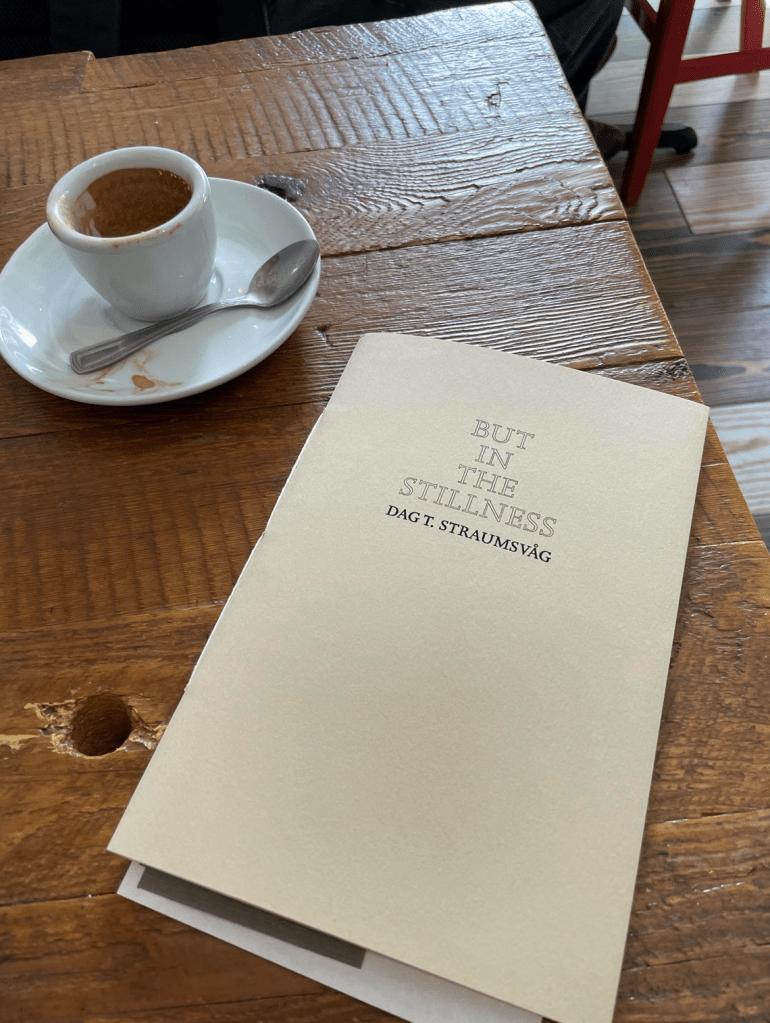
Dag T. Straumsvåg, But in the Stillness.  Ottawa, Ontario: Apt.9 Press, 2024, 80 copies.

apt9press.com

What do I mean when I say that Dag T. Straumsvåg’s poems are simple?  I mean that they are not “deceptively” but rather deliberately simple.  They wish for clarity and directness—to be what they appear to be, to say what they appear to say. 

Straumsvåg is a Norwegian poet who writes in English.  And this simplicity makes “But in the Stillness” a fine manuscript for Apt. 9 Press, whose editor and publisher, Cameron Anstee, has made a specialty of publishing poems that are direct, imagistic, and accessible.  But it is even a more perfect fit because the occasion for these poems is Straumsvåg’s learning of the death of Nelson Ball.  Ball, whose own brief, haiku-like works began to receive more attention in the later years of his life, has been a guiding light for the press.

Here is a joy-filled poem that reveals to us a world of poets connected to one another by interest and by friendship:

A box of eight

beautiful, beautifully

signed books

from Nelson Ball

landed

in my mailbox

on April 14, 2017

with a thump!

That day I felt good

about everything

in my life.

Don’t you find that “thump” so pleasing?  An earlier poem has informed us that Nelson Ball is terminally ill and so perhaps that knowledge also informs our reading of this poem, without diminishing the joy.

Not all the poems here refer to Ball; some are just about mosquitoes and insomnia and sitting down to pee.  There is an abundance of humour, that most human of responses to bad news, which seems to colour this two-line poem:

The houses don’t move. The cold doesn’t move. Silence

goes from door to door like a vacuum salesman.

In a later poem Straumsvåg learns that Ball’s assisted death has been scheduled and that another poet (Stuart Ross), the one who introduced Straumsvåg and Ball by email, would be attending.  Here the circle of poets seems to be lovingly drawing around the dying friend.  Meanwhile, Staumsvåg wonders how people in a room near him can be laughing, and writes a poem called “Accuracy” dedicated to Nelson Ball whose opening is a fine distillation of Ball’s own approach:

landing

A

universe

on

the

tip

of a leaf

While many of the poems are this brief and slim (much like Nelson Ball’s work), there are a good number of prose poems here that have more of a solid dailiness, a sense of larger life to them.  A nice example, “August 15, 2019” has the poet getting up at five a.m., making coffee, sitting at his kitchen table, watching people go by while remembering the night’s downpour, etc.  I like these poems very much, perhaps more than some of the lyrics that feel occasionally like attenuated haiku.  It’s in one of the prose poems permeated with sadness that we learn of Nelson Ball’s death.  But how lovely that he immediately follows it one day later with “The Morning Poet (August 17, 2019) in which the poet tells of how he loves reading Nelson Ball’s work morning, noon and night.  Friendship, love, joy, sadness are all emotions evoked with simplicity and depth in this touching tribute.