The museum of ordinary things

Dave Hickey, Safe Vehicules for a Dying Planet. London, Ontario: Baseline Press, 2021, 60 copies.

Dave Hickey is a ruminator, a thought-chewer who has no interest in hurrying himself to the end of a poem.  He’ll take a subject—for example, the aptly-named “Ladder”—and see what he can make of it.  One might have one “planted in the garden” yet be “no plant at all.”  Rather than being of value for themselves, ladders are “purposeful” in allowing us to “climb their backs.”  But then a ladder can be a useful metaphor as well, the rungs a sort-of calendar for marking off the time until the day of his daughter’s birth.  There is the slight fear brought on by a swaying ladder, the dubious usefulness (in his opinion, not mine) of a kitchen stepladder, the relationship between a ladder and a narrow staircase.  “And so to stand on a ladder is // to ask a good question with yourself” the poet says and one might think that he’s found his ending but no, there is still a thought or two to chew over and then a nice return to that young daughter who “looks up, / her mind wide // with the branches of trees.”

It isn’t surprising that Hickey likes a long line.  He shuns the use of empty space, the short, broken phrase, the single word floating on white paper.  It’s not ecstasy that he’s going for but something more quietly reflective and rational.  How else will he come to the conclusion that a hammock is a “Public monument to rest” that belongs in the “museum of ordinary things”? How else will he bring in his natural sense of humour in a poem such as “Umbilical”:

But what about things better left unbroken?

What about the traffic that speeds over a bridge

In a foreign city as a rainstorm approaches?

Bucharest, maybe?  Have you been? Am I

Stalling? Are you? What kind of question

is that, anyway?  How sharp are these scissors?

Who invented them? The scissors, I mean?

Can Dr. Scissors and I have a few words?

As can be seen from the above two-line stanzas (I have failed to put in the proper spacing), these poems don’t always have the reflective quality of a man leaning on a barn door with a stem of grass in the side of his mouth.  For every poem about “Sod” there’s another that somehow manages to combine that more leisurely style with an anxious energy.  It might be simply the need to “watch so your daughter won’t trip into the ditch / as you move up the trail, and keep her close that that when cyclists approach at unnerving speeds you can still reach out and pull her back”.  This from a poem (“Beehive”) that also insists “I want to be more present, you say to yourself,” invoking that tricky second person voice and showing the poet’s success and failure at the same time.  Unless a seeming uncontrollable talent for free-associating actually is a form of being present.

 These highly accomplished and readable poems perform a sort of high-wire balancing act, being particular and universal, thoughtful and near-panicky all at the same time.  There is an evocative image in a poem called “Tarp” of the poet wearing “a thought over my head until it catches the wind”.  I definitely want to be standing in that same field, seeing what the wind brings.

If only I could think of a deer

(Photo taken at Ideal Coffee, Ossington Avenue, Toronto.)

Amanda Merpaw, Put the Ghosts Down Between Us. Anstruther Press, 2021, 50 copies.

http://www.anstrutherpress.com/

It shouldn’t be so difficult, writing about Amanda Merpaw’s first chapbook, given how personal and human and wonderfully grounded these poems are. But Merpaw, despite her warm and relatable voice, is not always so straightforward. Her poems can also unsettle reality.

An easy entry might be the last poem, “Rhizomatic Thinking.” Here are the first lines:

We’re drinking coffee in January’s

bed. It’s raining. The harbour

hammers high at Lake Ontario.

what an inconvenience. The end

times, I mean. Can I unwelcome

the undoing? There’s burning beyond

the cusps of our cups. All of it,

actually, on fire. Last year I learned

to love a woman.

This feels like listening to a friend tell a story. There are many admirable traits, from the nice use of shorter and longer lines to the very effective enjambment. I particularly like “harbour / hammers” which delays and therefore emphasizes the alliteration, and “The end / times” which gently undermines and makes almost humorous the reference to all the shit that’s going on in the world. There’s also the movement, from the ordinary and personal to the larger crisis (but still expressed personally) to several more enigmatic lines. And then back to the personal confession. What a terrific opening.

In Merpaw’s poems I feel the poet’s mind working, leaping, associating, speculating, remembering, yet all somehow adding up to a coherent whole. The chapbook’s first poem, “Invocation,” has a characteristic fractured narrative. The poet spots a deer, claims to have first seen it on Toronto Island, refers to the place of the animal in the poem itself, questions whether she has really seen a deer at all, confesses to having drunk a lot of white wine, and discusses the ramifications of getting divorced by the age of thirty. Here are the last lines in which she returns to the deer:

I’ve looked for him in every

poem since, even this one.

Shh! Don’t! You’ll—

I’ve never been so still, not in love,

not meditating, not even in the kitchen mincing shallots for soup.

The poem has transformed the deer from an actual creature into one that lives within the work itself. Yet poetry, like a real deer, is timid and easy to frighten off (“Shh!”). It (the real dear, the imaginary one?) brings to the poet the gift of finding stillness while the poem itself, with that gorgeous last domestic scene, keeps moving.

“Cancelling the Future” is one of three prose poems, a form that Merpew already handles expertly, with their flow of memories and doubts and questions, their juxtaposition of surprising unlikely moments that nevertheless seem as if they were always meant to follow one after another. “At Kew Gardens” is a memory or perhaps a memorial for a relationship and brims with longing and regret, although the details already seem to be slipping away. “On the Spring Equinox” is both direct and cryptic, ordinary and aphoristic (“Can you stumble on grace uninvited?”), assertive and full of doubt.

I’ll end full circle with the last lines of “Rhizomatic Thinking.” How suffused with sensations, with those vivid yet questionable memories, with a hunger for nostalgia, and most of all with the need to put it all into words:

I tell you, I say, if only I could think

of a deer, see antlers sprout across

the air. Do you remember? From

the trail. After midnight. You weren’t

there. Yes, I should have been asleep.

Everywhere the night smelled

like dandelion fluff, like that pale dust

off Lake Ontario. It was an August

or two ago now. Maybe even three.

What a fine first collection this is. What an exhilarating reading experience. Put the Ghosts Down Between Us is my favourite among the chapbooks that I have read this year.

The only realism

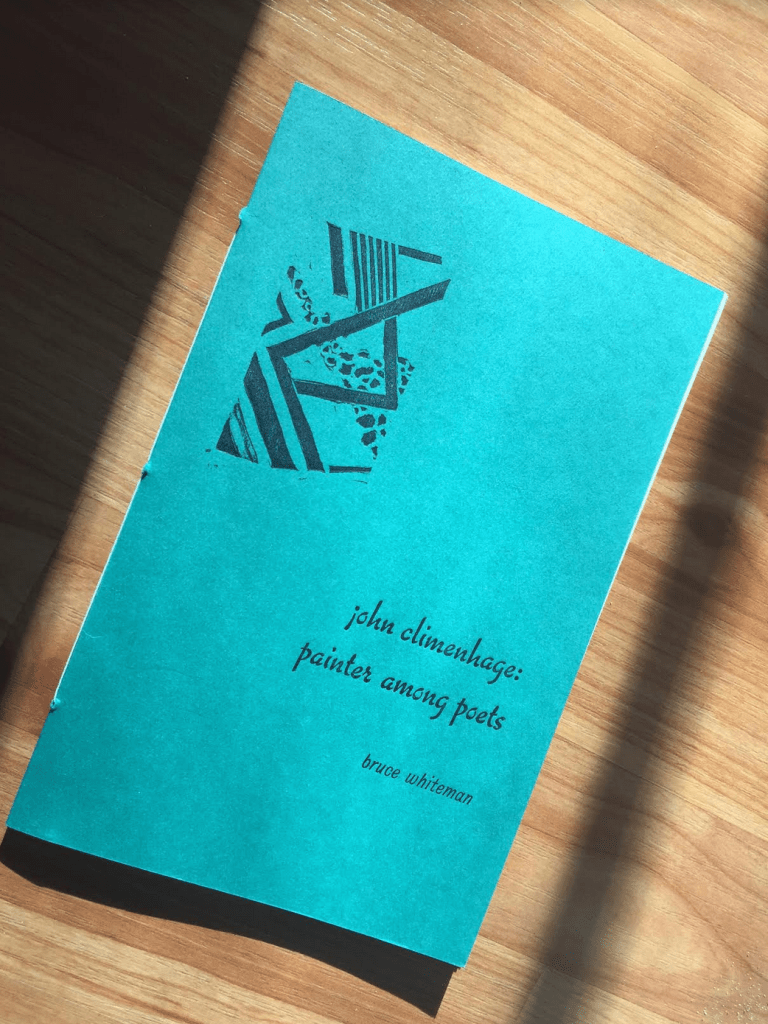
Bruce Whiteman, John Climenhage: painter among poets. Peterborough, Ontario: Poets & Painters Press, 2021, 50 copies.

For copies write to the author at: dbrucewhiteman@gmail.com

Bruce Whiteman has been a friend of mine for over forty years.  When we met I was twenty-one and running a little magazine and had accepted two of his poems.  I think it would be fair to say that chapbooks have played a significant role in that friendship.  The first one I ever published was a collection of his poems (The Sun at Your Thighs, the Moon at Your Lips, The Piraeus Press 1978.)    On a trip to Montreal together, we went to the Word bookshop and both bought a chapbook—the first book–by August Kleinzahler (The Sausage Master of Minsk, Villeneuve Press 1977).  Later when I was co-publisher of a new chapbook press he introduced me to Ralph Gustafson so that I might ask for a manuscript (Twelve Landscapes, Shaw Street Press 1985).  Since then Bruce has sent me a good number of chapbooks of his work, published by presses in Canada and the U.S.  And he has become a supporter of the press I’m now involved in (espresso), buying several of our titles and letting me know which ones he likes and which he doesn’t.

His latest chapbook, John Climenhage: Painter Among Poets, has just appeared and I am always pleased to see the form used for something other than poetry.  Climenhage is a Peterborough painter of expressive landscapes, cityscapes, and hockey players (johnclimenage.com) and the essay has been published for a new exhibit of his work at Peterborough’s Sadleir House.  Whiteman (so I will call him from now on) begins his essay on the relationship between poets and artists by invoking Pietro Aretino, who was friends with Titian.  He moves on to Baudelaire (Manet, Delacroix), Pound (Gaudier-Brzeska, Brancusi), William Carlos Williams (Matisse, Stieglitz), the New York Poets, and Raymond Souster.

Discovering that Ralph Gustason is a friend of John Climenhage allows him to write at some length on the poet, calling him “painterly” in the same way that some painters are called “poetic,” a designation that Whiteman shruggingly admits doesn’t mean very much.  It strikes me as interesting that the writer, obviously a fan of Climenhage’s work, nevertheless expends more words on Gustafson than he does on the painter.  That Whiteman ends not with any remark about Climenhage but with a quotation from William Carlos Williams (“The only realism in art is of the imagination”) is surely deliberate.  Perhaps he is asserting an earlier suggestion in the essay, that writing about painting really is impossible.  Or perhaps his real interest is more subtly personal: to think about his own relationship as a poet to the painters and paintings he so obviously cares about.

In either case, Bruce Whiteman offers the sort of essay that strikes me as unusual these days in its casually elegant erudition and its engagement in some perennial artistic questions.  He doesn’t show much interest in more recent critical theory or social concerns (for example, all the artistic milieus he mentions were dominated by men) and readers might find themselves wanting to interrupt now and then.  Nevertheless, or perhaps also for this reason, I think you’ll find this essay to be stimulating company.

The history of the future

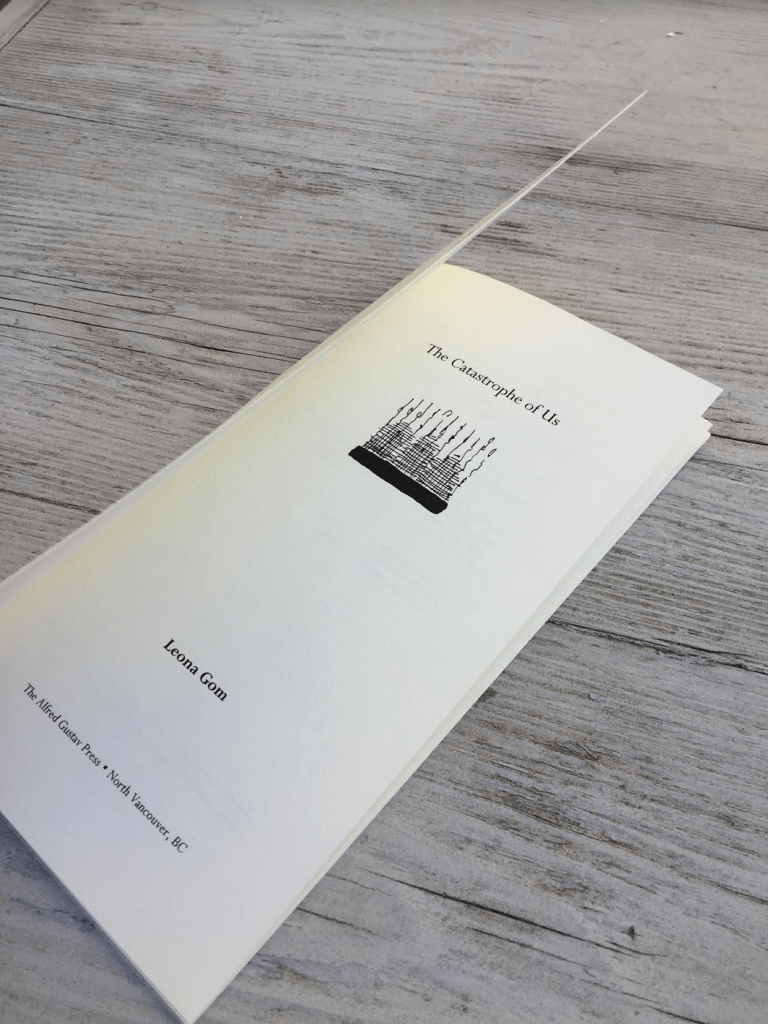
Leona Gom, The Catastrophe of Us. North Vancouver, BC: The Alfred Gustav Press, 2021.

http://d-zieroth.squarespace.com/the-alfred-gustav-press

The Alfred Gustav Press is, for me, a new and welcome discovery.  Published by the poet David Zieroth (and named for his father), the press’ attractive chapbooks are only available by subscription.  Every year those lucky subscribers receive three publications along with bonus chapbooks—new, short works by authors previously published by the press. 

Leona Gom’s The Catastrophe of Us is one heck of a bonus.  A short series of quasi-documentary poems based on reading recent books on history, the Anthropocene, and the universe, they rely on those texts for the information that is then turned into a succinct bulletin of alarm. 

The first poem sets the tone by giving us a thumbnail history of predictions of the end of the world, such as the Pope’s declaration on the Muslim conquest of Constantinople.  All this crying wolf has made it easy to dismiss the next Cassandra who comes along:

Because by now, into the next millennium,

we’ve had too many last days, because

the world has ended again and again,

because we have been hunted and haunted

by all the horsemen and all the prophesies

and all the extinctions and still come back

from them all.  Because we populate the world

again and again with our relentless survival,

doing more of what we’ve always done,

and in spite of all we know and because of it

we still expect the cycles of punishment

and forgiveness, our excuses now

both our knowledge and our ignorance.

Because we have written too often

the history of the future.

But as we all know by now, the (end) times they are a changin’.  The threats are real.  Some are politically created crises (bodies washed ashore in Malta), others more direct extinctions (“We are fierce with our murders and wars and genocides”).  Gom does, however, offer some dubious comfort in offering the fact that we are far less successful killers of humans than mosquitoes.   

Those efficient mosquitoes aside, our species does not come off well:

When told he might have shot

the last wild passenger pigeon,

the man went home and told his wife

that he was overcome with

pride and an unspeakable joy.

The wonder of it is that Gom has made such energetic poems out of her dour reading.  This small chapbook of smart, engaging and engaged poems have the peculiar effect of making you feel better and worse at the same time.  Worth the price of the whole 2021 subscription, I’d say.

Dear Tiny Vanities

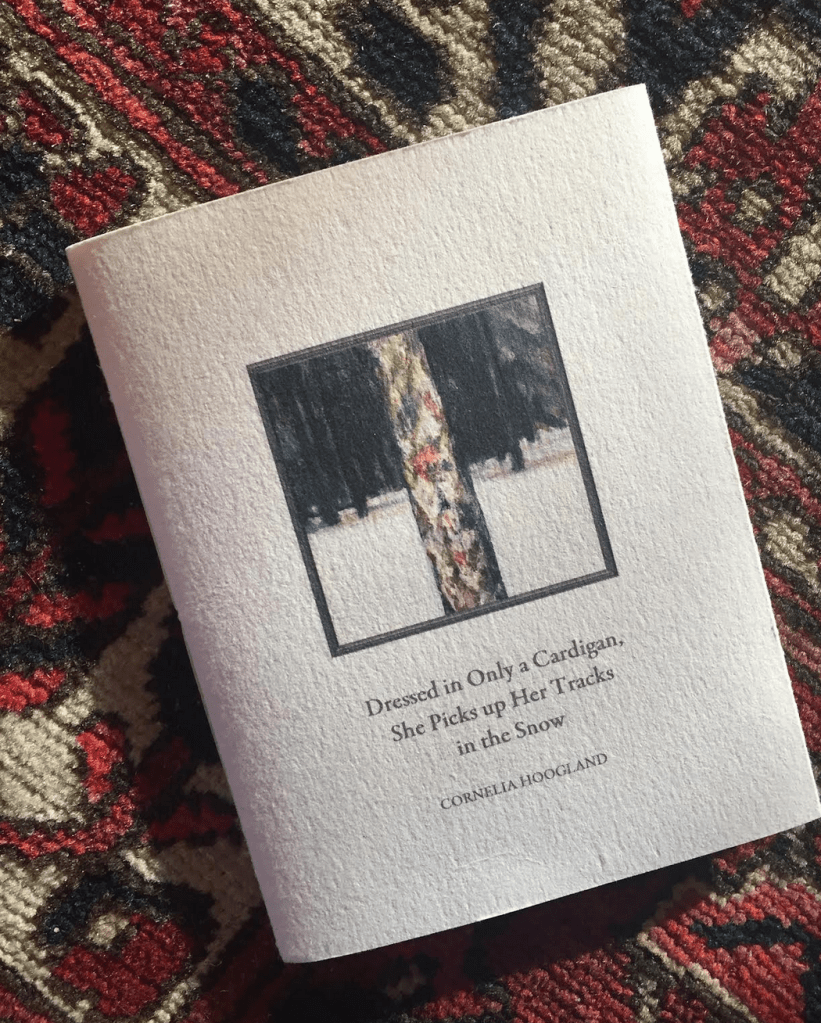
Cornelia Hoogland, Dressed in Only a Cardigan, She Picks Up Her Tracks in the Snow.  London, Ontario: baseline press, 2021, 60 copies.

Without doubt there are particular challenges in writing about a parent, whether blamed and resented or loved and admired.  The bad parent, while unfortunate in life, can make for some excellent dramatic material, while the good can easily lead the writer into the swamp of sentimentality.

Fortunately for her personal life, Cornelia Hoogland’s mother seems to have engendered only love and devotion from her daughter.  And fortunately for the reader, Hoogland still manages to avoid being gushy in this series of twelve prose poems about Wilhelmina Grootendorst Van Rooyen (1924-2019).  She has managed this by largely avoiding the mother/daughter relationship and instead by depicting Wilhelmina at the end of her life, as an independent but sometimes struggling woman in her 90s. 

There are earlier moments in the life as well.  Here is Wilhelmina’s father teaching her to swim by tying a rope round her waist and throwing her into the river.  And here she is, a young married now, crossing on the Volendam from Rotterdam to Quebec City.  The scenes that have the most effect, on me at least, are in old age; Wilhelmina needing help with her walker at the mall or talking to a photograph of her son even though she knows perfectly well that he has been dead for several years. 

There’s a particularly nice moment (and a nice sentence) when she speaks to an old friend on the phone:

88 years of friendship, 68 years of newsy letters, gossip about a friend’s luckless marriage back home, but never malicious, everything kind; a husband’s new job, same pay but better hours; Wilhelmina’s bowling score, old news by the time Binky receives it, but who else can she tell?

I also liked the image of her and her visiting sister posing for a photograph as they “straighten their 90-year-old backs.”  The poet cannot help turning into the daughter here: “Dear tiny vanities, long may you bind these women to the earth.”  All right, a little gushing, but can you blame her?

There doesn’t seem to be any scheme or plan to the sequence; rather, the poet has used what has come to her.  Wilhelmina’s mind drifts back to the Dutch landscape she left behind, or she is cozily watching Dr. Zhivago with a cousin.  Here are a few lines from the penultimate poem, the one that comes just before “Wilhelmina in Heaven”:

Wilhelmina feels a chill.  Sets her plate in the sink, follows her aluminum walker that glides over the floor on its stockinged feet.  A Little Nap.  Sits on her bed, removes her coat, places her glasses beside the clock.  And now everything shrinks, every action, every thought, is spliced in half and again.

But Wilhelmina is never reduced for us.  Her full life, her memories, the way she holds onto the people who matter to her—all of that remains fiercely present.

Faces Everywhere

Alix Hawley, Your Eye: On Photography. Windsor, Ontario: Woodbridge Farm Books, 100 copies, 2019.

https://thewoodbridgefarm.com/chapbooks

I very much like the idea of a chapbook publisher encouraging the creation of new texts, and Woodbridge Farm Books has found quite a nice idea for doing so.  “Writers at Rest: Authors on their Pastimes & Hobbies” is the name of a series that is meant to complement a residency program. Participants are asked to write about something other than their work.  A writer not talking about writing?  What a swell idea.

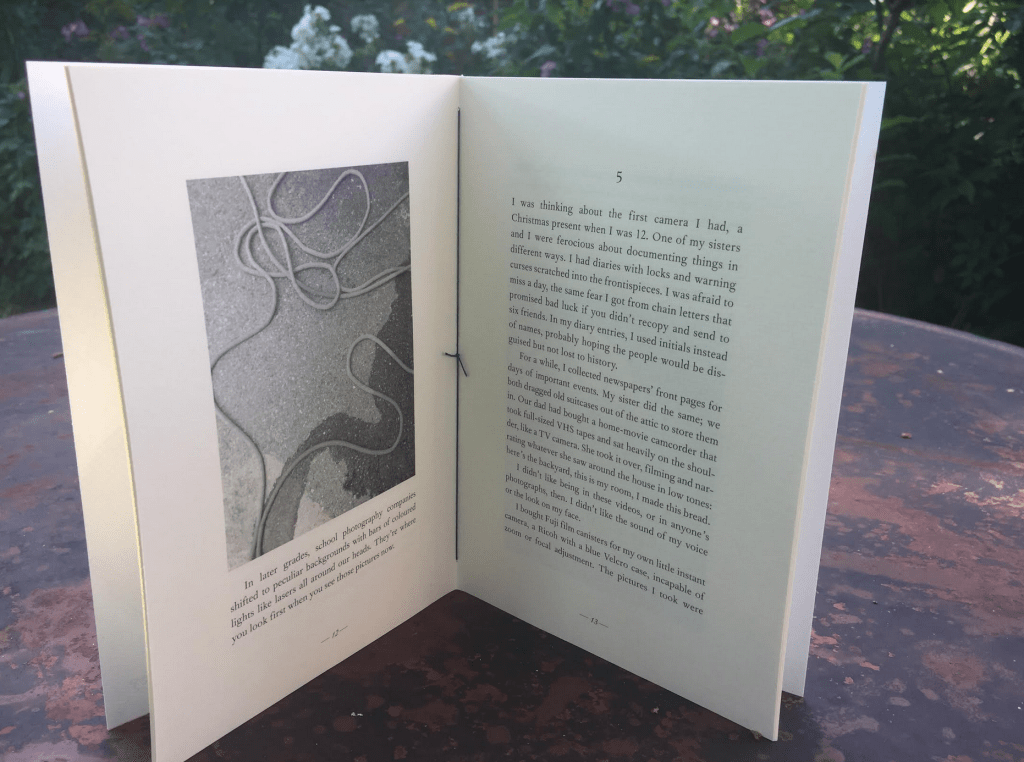
The fiction writer Alix Hawley’s “Your Eye: On Photography” is the third in the series.  First I must complement the look and feel of these small chapbooks—everything from the dimensions to the Zephyr laid paper (a tip-off that the book has been printed by Coach House Books) to the small, clean type is admirable, and the two that I own are graced with images as well.

Hawley is refreshingly uninterested in taking photographs for any reason other than her own pleasure, although she does share them on Instagram.  In fact, it was her need to feed that particular social-media beast that encouraged her to return to a practice that she had once enjoyed as a kid.  But in a series of associations around the idea of making images she goes back farther:

First, I thought about a friend I had in preschool, whose face I can’t remember.  Just her hair, thick and dark as an ebony frame.  I thought about being very young and closer to the ground-level and to things in general, the way you find faces everywhere then, in tree bark or twisted sheets.

She goes on to find the origin of her eye for ordinary things: 

If I’d had a camera then, I probably would have taken pictures of the shower, the dark closet, the cat as seen from the rear….  Maybe I’d photograph the house, with its chimney and green roof.  Maybe adults’ stalky legs.  Maybe my toys.  Probably not my younger siblings.   Probably no human faces, which didn’t seem so important or so close.

If I’m not careful, this review will be nothing but direct, telling quotations.  Hawley thinks about (every section begins with “thinking” about something) finger-painting, about the appeal of garbage, about school photographs.  She has a very precise visual memory, recalling the colour of the school photo backgrounds (“a flat dry blue like a cake of unused paint”) and how the photographer asked them to look up in a certain way, “as if we were maybe at an airport waiting for planes to deliver gifts or relatives.”

She received her first camera, a simple point-and-shoot Ricoh, when she was twelve.  Inevitably, the prints that came back from the drugstore were disappointing.  Then the camera got lost and so did the hobby until adulthood, when she directed her phone away from the kids and towards a C-shaped picnic table that, along with its shadow, became almost abstract.  Since then have come many more, taken quickly and carelessly, without thought.  Without, she does not say, the thought that writing demands, but it is easy to see how refreshing such a practice might be.

Interestingly, the last association isn’t about photography at all but learning to drive and the taking of a colour-blindness test.  There’s nothing definitive about the essay, nothing formal. Instead, perhaps it is a writer allowing herself to do in words what she usually reserves for the camera: don’t think, just write.

We have lots of water

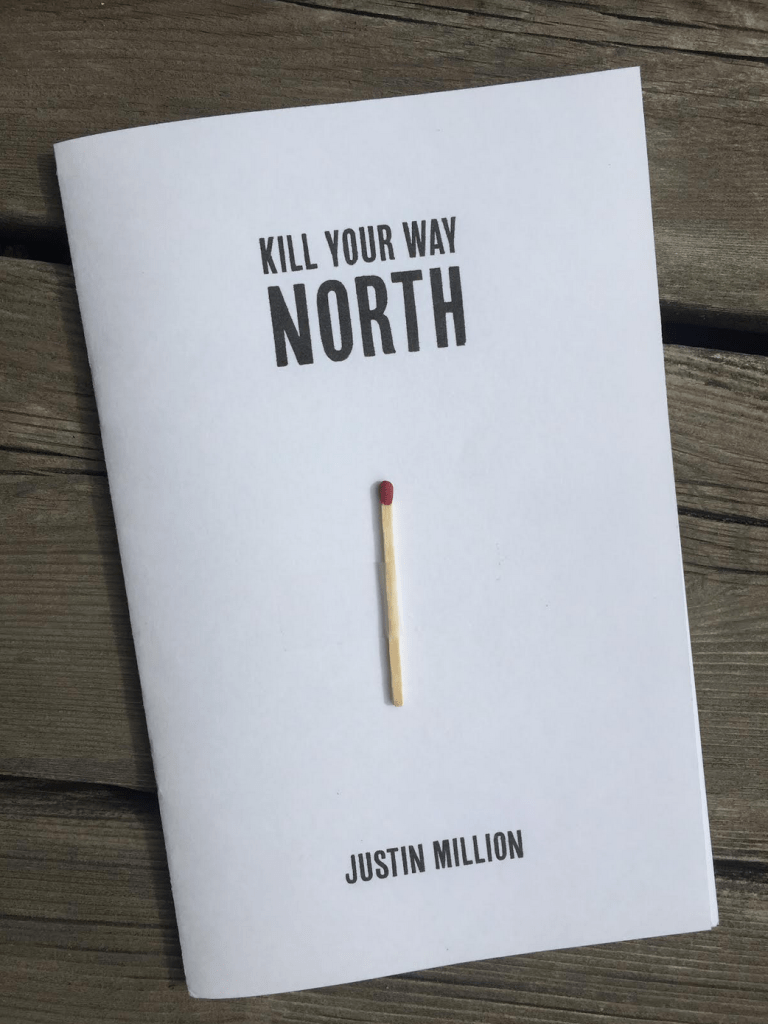
Justin Million, Kill Your Way North. Peterborough, Ontario: bird, buried press, 50 copies, 2020.

https://birdburiedpress.wordpress.com/

Let it be said that I like a good dystopian, apocalyptic literary novel as much as the next person.  Cormac McCarthy’s The Road?  Check.  P.D. James’ Children of Men?  Done.  Emily St. John Mandel’s Station 11? Roger that.  But I had not encountered a dystopian, apocalyptic poem in which characters keep moving, weapons handy, and try not to remember the before days when there were “tall cans and peanut butter.”  Not, at least, before reading Justin Million’s chilling poetry sequence with a title that sounds like the kind of movie I watch when my partner is out for the night.

But it’s time to put the joking tone aside, for Million is not in a joking mood and given the state of the world and the prognosis for the future, there’s no reason he should be.  The short lines and fragmented sections of Kill Your Way North do an admirable job of conveying the alternating emotions of sadness, desperation, fear, and anger, while keeping the narrative rolling the way the characters themselves keep moving ahead.

            We have to

            Kill

            To survive

            We have to

            Have that

capacity

The characters include the speaker (presumably male), his female partner, and a dog.  The dog is the only one with a name—Nutmeg—and I suppose it’s ironic that the pooch eventually gets eaten and receives one last “good girl” from her affectionate owner.    They are moving through the woods of northern Ontario towards Provoking Lake, an exquisite spot near Algonquin Park (I looked at online photographs).  Along the way they encounter a stranger:

            We have not achieved telepathy

            so

            she does

            that passé romantic gesture

            and puts her finger

            to my lips

            to remind me to shut the fuck up

The stranger has a gun but the poet’s partner is faster with her knife and while she ends up with “thick blood/on her hands” she also reminds us that there is no need to descend into barbarism and that these new kills “shouldn’t be praised”.

Apparently, it is hard to keep an artist down, for the speaker is writing a play and tells us, without any irony that I can detect, “I’m sure/there will be a crowd somewhere for it”.  Even so, there’s not much hope to be found in this poem, nor belief in anything communal or collective or spiritual.  Not when “the individual’s/the new nation”.  Justin Million’s poem is a brief nightmare vision of the future, with a violent narrative to keep the pulse raising and—for good measure—a real match on the cover just in case we need to use the chapbook as kindling for our own fire.

I jumped on the trampoline

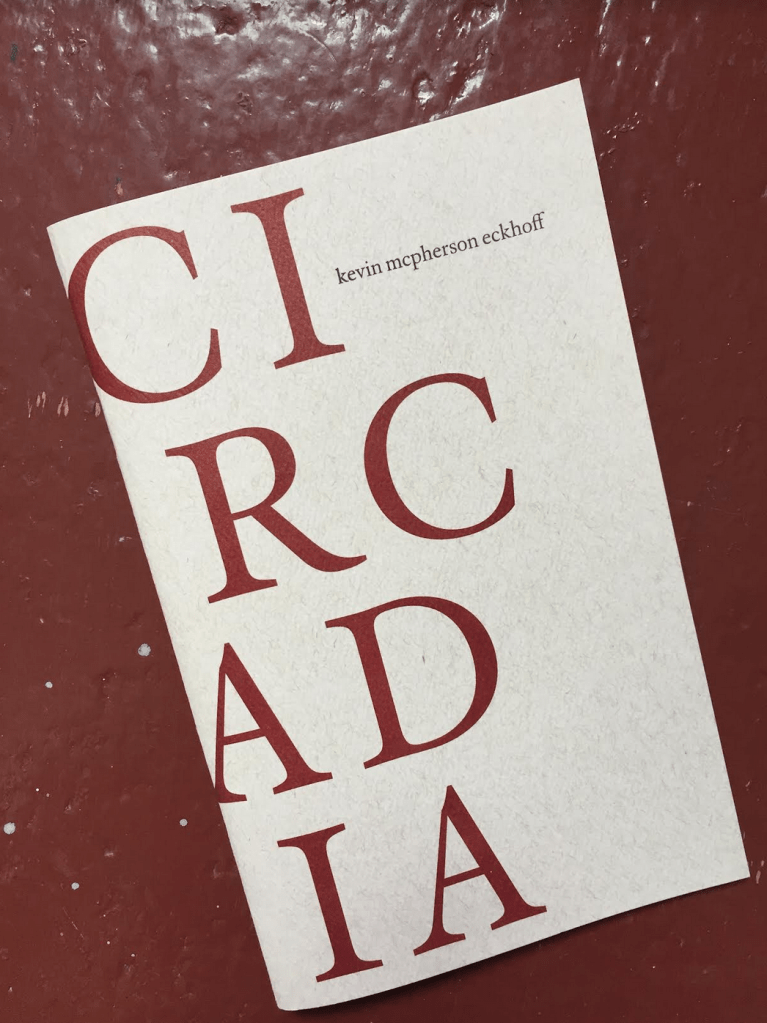
Kevin Mcpherson Eckhoff, Circadia.  Kentville, Nova Scotia: Gasperau Press (Devil’s Whim Chapbook #37), 400 copies, 2018.

http://www.gaspereau.com

Turns out it is possible  to cover a whole poetic year in a 32-page chapbook.  All one needs to do is condense each month into a single poem, and to do that all one needs to do is write a single line a day.

This appears to have been Kevin Mcpherson Eckhoff’s strategy in the clever, personal, funny, occasionally self-indulgent and highly readable Circadia.  Here are the first lines from “January,” naturally the first in the 12-poem series:

I fried some Mennonite sausage.  I watched 18

Minutes from somewhere in the middle of Pirates of

The Carribbean: The Curse of the Black Pearl.  I got a

Birthday card.  I cleaned the hedgehod’s hutch.  I

Lifted some weights.  I learned that I have anterior

Spondylolisthesis, coinciding with a previously

Fractured pars interarticularis, which sounds way

Worse than it is, I think.  I finished a crossword

Puzzle.

During the year we discover that the poet has a female partner, two young boys, does some acting, watches parts of movies, is quite handy around the house, doesn’t have sex, does have sex, lifts weights annoyingly often, drinks a lot of coffee, takes care of the garden, wishes he could live in a big city (he’s somewhere in B.C.), has a best friend, will save a kitten when necessary, doesn’t like to kill small creatures (even accidentally), rolls down hills and holds his children when they nap but sometimes grows tired of them, runs, drinks, and cuts down his own Christmas tree. 

I suppose these are prose poems, since they are set ragged right rather than with line breaks designated by the author, and there are no other signs of prosody.  There is an awareness of more prose-like rhythm and sentence length, although as far as I can tell no deliberate rise or fall or other shaping of the order of events.  One poem ends with “I wanted a pet bat” and the chapbook’s last line is one of many references to food: “I ate three slices of homemade pizza.”  The special moment is not privileged over the ordinary.  Almost all the lines begin with “I”—clearly a deliberate strategy and partly responsible for the feeling of self-indulgence, while also keeping the other figures in the background.  But hey, aren’t we all really Matt Damon in the movie of our life?

Are there times when I wished for a little more depth, or emotional vulnerability, or surprise, or even just a moment of lingering sadness?  Sure.  But maybe Kevin Mcpherson Eckhoff isn’t that sort of guy.  Maybe he’s always moving on to the next chore, the next game with the kids, the next slice of pizza.  I bet he makes a swell best friend.

I have always been careless

patricia young

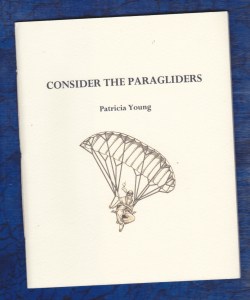
Patricia Young, Consider the Paragliders.  London, Ontario: baseline press, 60 copies, 2017.

http://www.baselinepress.ca

And really, what is a prose poem?  Like a novella, it’s a hard, perhaps impossible thing to define.  One description I came across was a short work of prose that reads as if it were poetry.  Of course the next question is: does it matter?  Patricia Young calls the eighteen paragraphs in Consider the Paragliders prose poems but they read to me (most of them, anyway) like miniature stories.  Perhaps it’s a matter of you say tomatoes, I say tomahtoes.  Either way, I very much like what I’m being served.

Here’s the first line of the first poem: “He grew up in a blue room by the sea, the light so hard and luminous it ricocheted off the walls.” It has a character, a setting, and the hint of a narrative to come.  It’s also quite a beautiful line, the room itself seeming to become the sea, as if the child is submerged in its blueness, a comforting image were not not disturbed by the violent energy of “ricocheted.”  And in a handful of sentences about solitude, stargazing, and an angry father, we are given a vivid portrait of the unhappy childhood of boys.

This first poem has a stand-alone feel, but it is followed by a short series that deliberately gives the feeling of autobiography or memoir (of the character, not necessarily the author).  First she is a thirteen-year-old girl, paid by a neighbour to move boxes.  Then she is eighteen and pregnant, using an empty suitcase found on the beach (a wonderful, Ondaatje-like image) to make her escape.  Next she is asleep on a floor, her babe resting in a crate beside her, his skin smelling  “Like a Fuji apple wrapped in red tissue”.   It’s the delicacy of such images, perhaps, that make this poetry.

Again the narrative line seems to shift with a poem (playfully named “Story”) that begins: “My husband’s missing arm was a mystery.”  Some of the pieces have a dreamlike, or perhaps surreal quality, such as the marvellous “Some Questions” which I take the liberty of reproducing here:

patricia young 2

The two short lines on the left-hand side, by the way, are the ends of the binder’s knot.  The chapbook, like all the publications from baseline, is a carefully made object, the cover and inside pages printed on heavy paper from the La Papeterie St-Armand in Montreal. It is beautiful without being excessively precious, or one of those book objects that one is afraid to touch.

These poems have a sort of weary wonder to my ear, the work of a dedicated, experienced poet who continues to find life mystifying and beautiful, brimming with regret and forgiveness.  There are many more lines I want to quote, such as this one: “I have always been careless with people and now it’s too late.”

But not too late to write about them.

-C.F.


Pointing Into the Thicket

abel 1 2

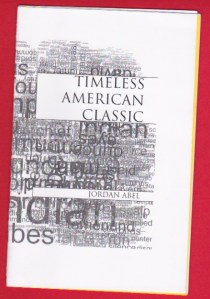
Jordan Abel, Timeless American Classic.  Ottawa: above/ground press, 2017.

http://abovegroundpress.blogspot.ca

I am writing this while we are in the midst of a heated and painful debate about voice appropriation and Indigenous authors that we surely all hope will, in the end, be useful and productive.  Access to publishing is a relevant issue at all levels of publishing, even the micro level, but those of us who read chapbooks can rely on rob mclennan to provide a host of interesting voices with his busy above/ground imprint.

Jordan Abel is a Nisga’a writer who lives in B.C.  He writes in the afterword:

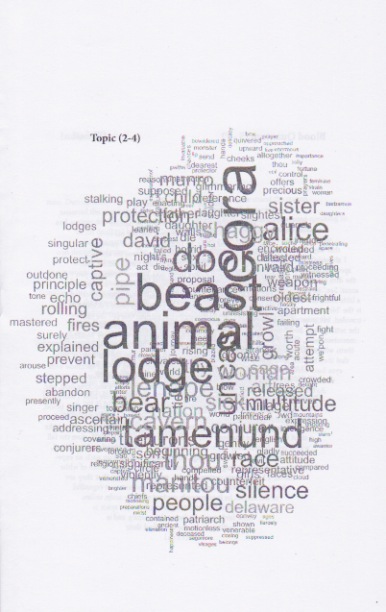
The pieces in Timeless American Classic are all derivations and creative distant readings of James Fenimore Cooper’s novel The Last of the Mohicans.  This project was in part inspired by Roxanne Dunbar-Ortiz’s argument (in An Indigenous Peoples’ History of the United States) that Cooper’s novel plays a role in reinventing the colonial origins of the United States, and in creating a narrative that was “instrumental in nullifying guilt related to genocide.”  Ultimately, this project seeks to disrupt the colonial logic in the novel by displacing (and reorienting) the text itself in order to expose the problematic representation of Indigenous peoples.  The project is also deeply inspired by current digital humanities techniques of visualization, machine reading, and algorithmic allocation.

My first thought was that Cooper’s 1826 novel was not really on our Canadian radar as a significant text, but my second was that anything that influenced the standard American narrative must surely be an influence on us here in Canada.  There are various ways of exposing or upending that narrative. One is through protest, newspaper editorials, film, etc. – in other words, through the media in ways that reach a large number of people.  But another way is quieter, its canvas smaller, Timeless American Classic being an excellent example of that.  If small-circulation chapbooks matter at all, then they matter here as well.

Abel’s method, as I make it out, is two-fold.  In the first, he draws out phrases from Cooper’s novel that contain the word “Indian” and isolates them in parallel texts with the word itself running forcefully down the centre.  Here is a reproduced example:

abel 2

The second way is to create a kind of visual collage, either by overlapping sentences or by (as in the following example) employing different text sizes and directions and grey scales:

abel 3

I don’t know much about “current digital humanities techniques” or “algorithmic allocation” and it’s more than likely that some of the results of this text play is lost on me. I find both quite effective visually and that their general impact is strong.  I find it much harder to actually read every word on a page (am I supposed to?); rather, my eye skips from here to there, picking up a word or phrase.  Is it ironic that the collage-like pages are so visually appealing?

The book begins with a useful quotation from Roxanne Dunbar-Ortiz so that, all in all, this modestly-appearing chapbook provides a powerful introduction to both the influence of a “classic” text and the way in which that influence might be challenged.

-C.F.