Natural decay

Helen Humphreys, In Conversation with the Wild: On Drawing Nature. Kingsville, Ontario: Woodbridge Farm Books, 2024, 100 copies.

https://thewoodbridgefarm.com/shop

Helen Humphrey’s books have shown her to be a quiet, elegant, thoughtful writer.  And with a highly developed sensitivity to the natural world.  I’m thinking, for example, of the sustaining beauty of birds in wartime in The Evening Chorus.  So it is not surprising to discover that Humphrey herself is sustained by nature—more specifically by drawing the ordinary flora of her world.

In Conversation With the Wild is the latest chapbook in the remarkable “Writers at Rest” series from Woodbridge Farm Books.  Here authors are given space to write about their non-literary interests; for Helen Humphreys, it’s making botanical drawings of branches, acorns, seed pods, and, above all, waterlily pads. As someone who has found himself obsessed with various past-times over the years, I thoroughly enjoyed reading about Humphrey’s dedicated effort to learn to draw.  How she took lessons, worked at it doggedly, and used her pandemic time to take a demanding botanical illustration course through the Edinburgh Royal Botanic Gardens.  Also, how it became an extension of her own daily routine.  “This summer I went swimming almost every morning in a lake just north of Kingston,” is how the essay begins.  “I went with a friend and took my dog.”  At the end of summer she “plucked a few waterlily pads from near the shore to take home to draw.”
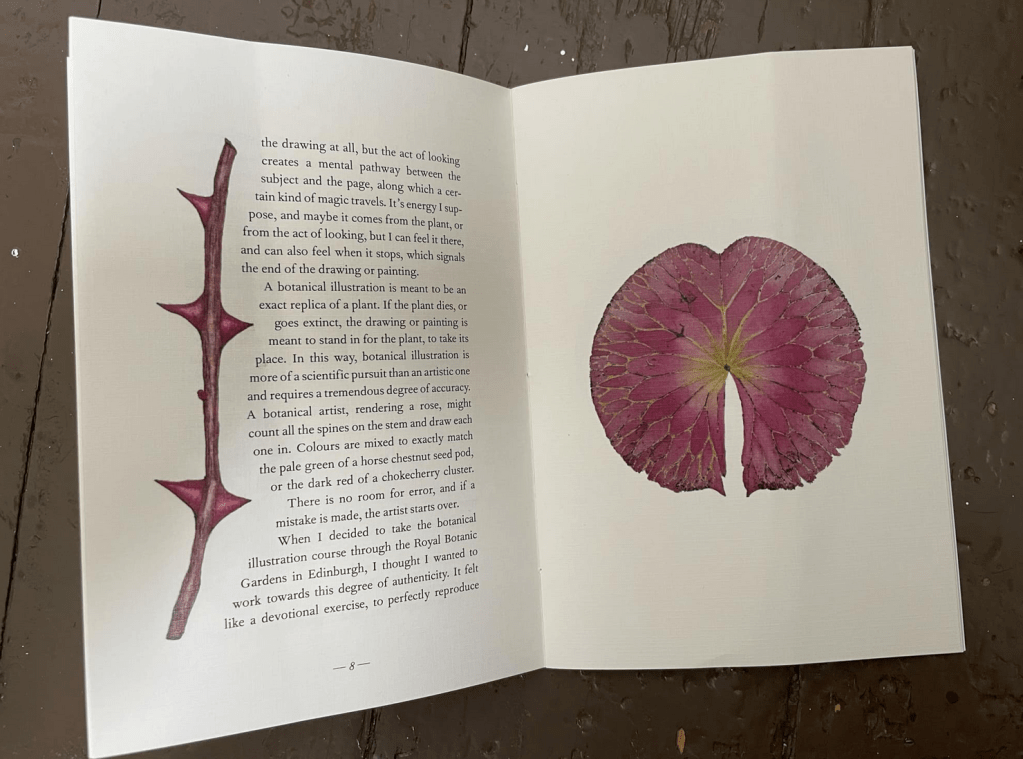
Humphrey discovered that once taken from the lake, the waterlily pads began to suffer from “natural decay.”  She learned to keep them submerged in water.  She describes her attempts to draw them, when “the act of looking creates a mental pathway between the subject and the page, along which a certain kind of magic travels.”  That magic she finds hard to explain, other than to call it energy that either comes from the plant itself or from the “act of looking” and here I wish she had pushed just a little harder to find more a precise understanding of what she’s feeling.  On the other hand, I can sympathize with a desire to leave things a mystery. 

The chapbook is generously illustrated and I can see that, while she is not a “professional” illustrator, Humphrey has become an accomplished amateur.  And while she spends some time contrasting the experience of writing and drawing, her images remind me of her writing: careful, delicate, and subtle in their transformation of the real world into art. 
Beautiful, beautifully

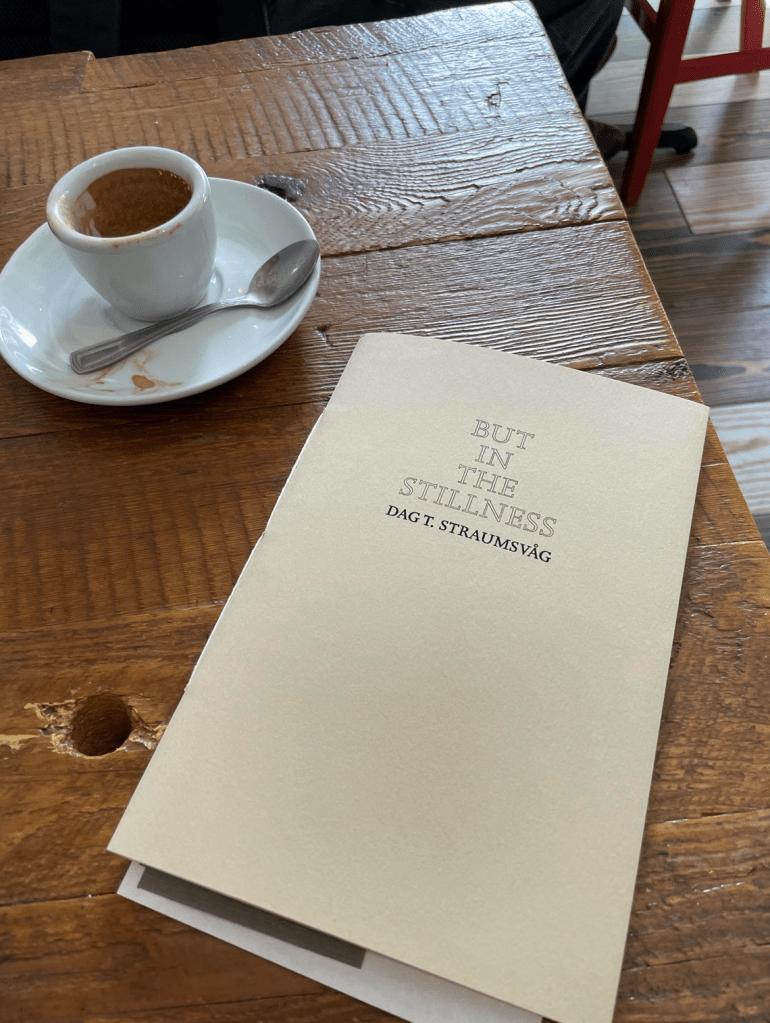
Dag T. Straumsvåg, But in the Stillness.  Ottawa, Ontario: Apt.9 Press, 2024, 80 copies.

apt9press.com

What do I mean when I say that Dag T. Straumsvåg’s poems are simple?  I mean that they are not “deceptively” but rather deliberately simple.  They wish for clarity and directness—to be what they appear to be, to say what they appear to say. 

Straumsvåg is a Norwegian poet who writes in English.  And this simplicity makes “But in the Stillness” a fine manuscript for Apt. 9 Press, whose editor and publisher, Cameron Anstee, has made a specialty of publishing poems that are direct, imagistic, and accessible.  But it is even a more perfect fit because the occasion for these poems is Straumsvåg’s learning of the death of Nelson Ball.  Ball, whose own brief, haiku-like works began to receive more attention in the later years of his life, has been a guiding light for the press.

Here is a joy-filled poem that reveals to us a world of poets connected to one another by interest and by friendship:

A box of eight

beautiful, beautifully

signed books

from Nelson Ball

landed

in my mailbox

on April 14, 2017

with a thump!

That day I felt good

about everything

in my life.

Don’t you find that “thump” so pleasing?  An earlier poem has informed us that Nelson Ball is terminally ill and so perhaps that knowledge also informs our reading of this poem, without diminishing the joy.

Not all the poems here refer to Ball; some are just about mosquitoes and insomnia and sitting down to pee.  There is an abundance of humour, that most human of responses to bad news, which seems to colour this two-line poem:

The houses don’t move. The cold doesn’t move. Silence

goes from door to door like a vacuum salesman.

In a later poem Straumsvåg learns that Ball’s assisted death has been scheduled and that another poet (Stuart Ross), the one who introduced Straumsvåg and Ball by email, would be attending.  Here the circle of poets seems to be lovingly drawing around the dying friend.  Meanwhile, Staumsvåg wonders how people in a room near him can be laughing, and writes a poem called “Accuracy” dedicated to Nelson Ball whose opening is a fine distillation of Ball’s own approach:

landing

A

universe

on

the

tip

of a leaf

While many of the poems are this brief and slim (much like Nelson Ball’s work), there are a good number of prose poems here that have more of a solid dailiness, a sense of larger life to them.  A nice example, “August 15, 2019” has the poet getting up at five a.m., making coffee, sitting at his kitchen table, watching people go by while remembering the night’s downpour, etc.  I like these poems very much, perhaps more than some of the lyrics that feel occasionally like attenuated haiku.  It’s in one of the prose poems permeated with sadness that we learn of Nelson Ball’s death.  But how lovely that he immediately follows it one day later with “The Morning Poet (August 17, 2019) in which the poet tells of how he loves reading Nelson Ball’s work morning, noon and night.  Friendship, love, joy, sadness are all emotions evoked with simplicity and depth in this touching tribute.