
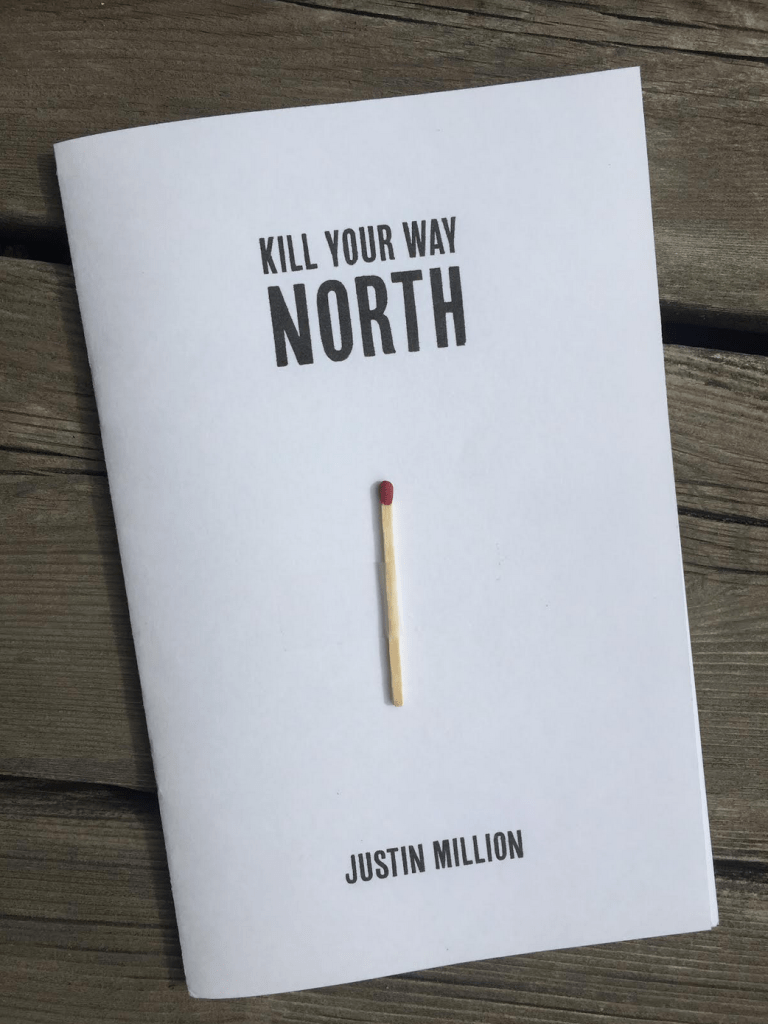
Alix Hawley, Your Eye: On Photography. Windsor, Ontario: Woodbridge Farm Books, 100 copies, 2019.
https://thewoodbridgefarm.com/chapbooks
I very much like the idea of a chapbook publisher encouraging the creation of new texts, and Woodbridge Farm Books has found quite a nice idea for doing so. “Writers at Rest: Authors on their Pastimes & Hobbies” is the name of a series that is meant to complement a residency program. Participants are asked to write about something other than their work. A writer not talking about writing? What a swell idea.
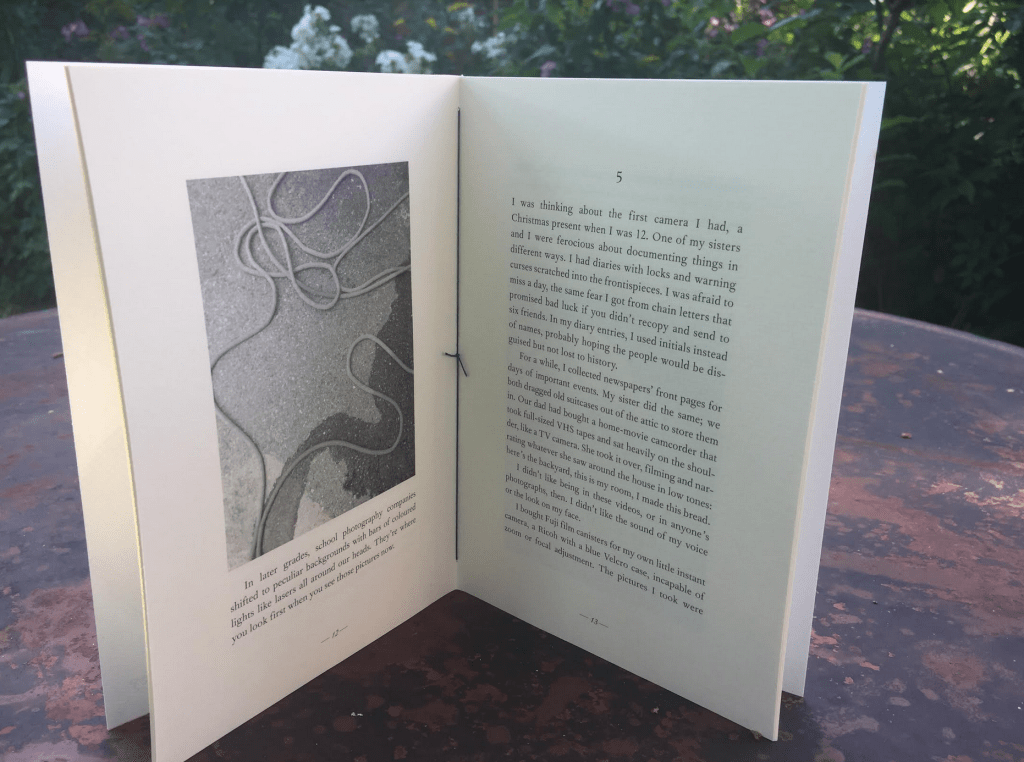
The fiction writer Alix Hawley’s “Your Eye: On Photography” is the third in the series. First I must complement the look and feel of these small chapbooks—everything from the dimensions to the Zephyr laid paper (a tip-off that the book has been printed by Coach House Books) to the small, clean type is admirable, and the two that I own are graced with images as well.
Hawley is refreshingly uninterested in taking photographs for any reason other than her own pleasure, although she does share them on Instagram. In fact, it was her need to feed that particular social-media beast that encouraged her to return to a practice that she had once enjoyed as a kid. But in a series of associations around the idea of making images she goes back farther:
First, I thought about a friend I had in preschool, whose face I can’t remember. Just her hair, thick and dark as an ebony frame. I thought about being very young and closer to the ground-level and to things in general, the way you find faces everywhere then, in tree bark or twisted sheets.
She goes on to find the origin of her eye for ordinary things:
If I’d had a camera then, I probably would have taken pictures of the shower, the dark closet, the cat as seen from the rear…. Maybe I’d photograph the house, with its chimney and green roof. Maybe adults’ stalky legs. Maybe my toys. Probably not my younger siblings. Probably no human faces, which didn’t seem so important or so close.
If I’m not careful, this review will be nothing but direct, telling quotations. Hawley thinks about (every section begins with “thinking” about something) finger-painting, about the appeal of garbage, about school photographs. She has a very precise visual memory, recalling the colour of the school photo backgrounds (“a flat dry blue like a cake of unused paint”) and how the photographer asked them to look up in a certain way, “as if we were maybe at an airport waiting for planes to deliver gifts or relatives.”
She received her first camera, a simple point-and-shoot Ricoh, when she was twelve. Inevitably, the prints that came back from the drugstore were disappointing. Then the camera got lost and so did the hobby until adulthood, when she directed her phone away from the kids and towards a C-shaped picnic table that, along with its shadow, became almost abstract. Since then have come many more, taken quickly and carelessly, without thought. Without, she does not say, the thought that writing demands, but it is easy to see how refreshing such a practice might be.
Interestingly, the last association isn’t about photography at all but learning to drive and the taking of a colour-blindness test. There’s nothing definitive about the essay, nothing formal. Instead, perhaps it is a writer allowing herself to do in words what she usually reserves for the camera: don’t think, just write.
 Word Music